
At Kramer & Duyvis, we know better than anyone that an efficient production line is the lifeblood of your business. With more than 80 years of experience in mechanical engineering, we see every day how the right conveying solutions can make the difference.
Curved conveyors are often indispensable, especially in production facilities with complex layouts or where product orientation is critical. But how do you ensure that these curves not only function properly, but also contribute to a longer service life of your equipment and maximum safety?
Based on our technical guidelines, we are pleased to share the key considerations for selecting and using curved conveyors.
The 9 Golden Rules for Your Curved Conveyor
1. Respect the Minimum Outer Radius
A curve that is too tight leads to accelerated wear. For optimal performance, we recommend an outer radius of at least 2× the belt width. This ensures smooth conveying and reduces stress on the material.
2. Speed and Centering Are Key
In curves, products are subject to centrifugal forces. Make sure the product is centered on the belt and limit the speed in the curve to prevent products from sliding or tipping.
3. Ensure Smooth Transitions
Use transition modules to create a seamless connection between straight sections and curves. This not only improves product flow but also contributes to a safer working environment.
4. Apply the Correct Belt Tension
Proper belt tension is essential—however, overtightening is detrimental. Excessive tension accelerates wear on various components. Correct tension ensures a longer service life.
5. Know Your Product
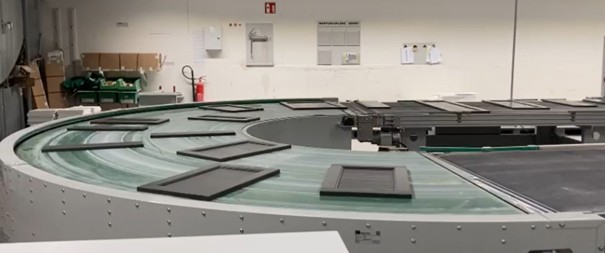
Not every product behaves the same way in a curve. Verify whether the shape, rigidity, and hygiene requirements of your product are suitable for curved conveying. Also consider that product orientation may change when passing through a curve.
To accommodate this wide range of applications, we offer various solutions—please refer to our product range.
6. Consider Maintenance and Hygiene
Select materials and belt types that meet your hygiene requirements (for example, in the food industry). In addition, ensure that the conveyor is easily accessible for inspection and cleaning.
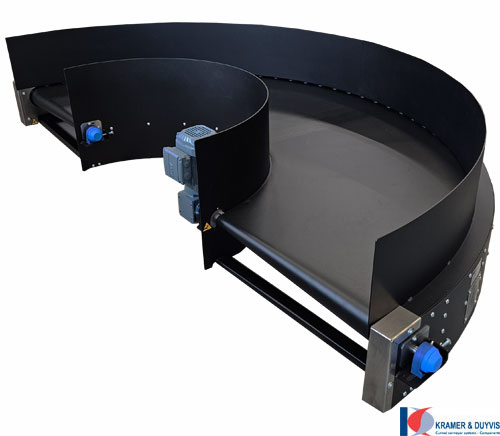
7. Use Side Guides Where Necessary
Curved conveyors often require raised edges or side guides to keep products on the belt. However, ensure there is sufficient clearance between the product and the guide to prevent jamming or blockage.
8. Take Product Dimensions into Account Using the 50–75 Rule
To prevent congestion, the belt should always be wider than the product. A good rule of thumb is to allow 50 to 75 mm of clearance between the product and the outer radius. This makes it easy to calculate the minimum belt width required.
9. Pay Attention to Speed Differences
Did you know that the belt moves faster at the outer radius than at the inner radius? For optimal performance, the nominal belt speed should match the straight conveyor sections before and after the curve. When conveying multiple products side by side, the speed at the inner radius should be aligned with the infeed conveyor.
Need Advice?
All of our curved conveyors are custom-built to meet the specific requirements of your production environment. From a single curve to a complete new layout solution—Kramer & Duyvis is ready to support you.
Find Your Solution!
Explore our full product range on our website and discover the solution that best fits your needs.
Do you have questions about integrating curved conveyors into your line? Take a look at our 3D Configurator or feel free to contact us—we’re happy to help.